Planned trips in the Polarsteps app, along with an extensive traveler survey, reveal what’s on the horizon for the upcoming summer season of travel: geopolitical uncertainty is redirecting travel and dividing generations; the thirst for (and willingness to spend more on) travel grows; and sources of inspiration are fracturing along generational lines, with AI already outpacing Instagram, and social media creating a growing gap between expectation and reality. In terms of upcoming destinations, Europe is still dominating summer trips for Polarsteps travelers, but significant shifts are taking place.

With the conflict in the Middle East and rising political friction in the United States, it’s not surprising that travelers' decisions are shifting.
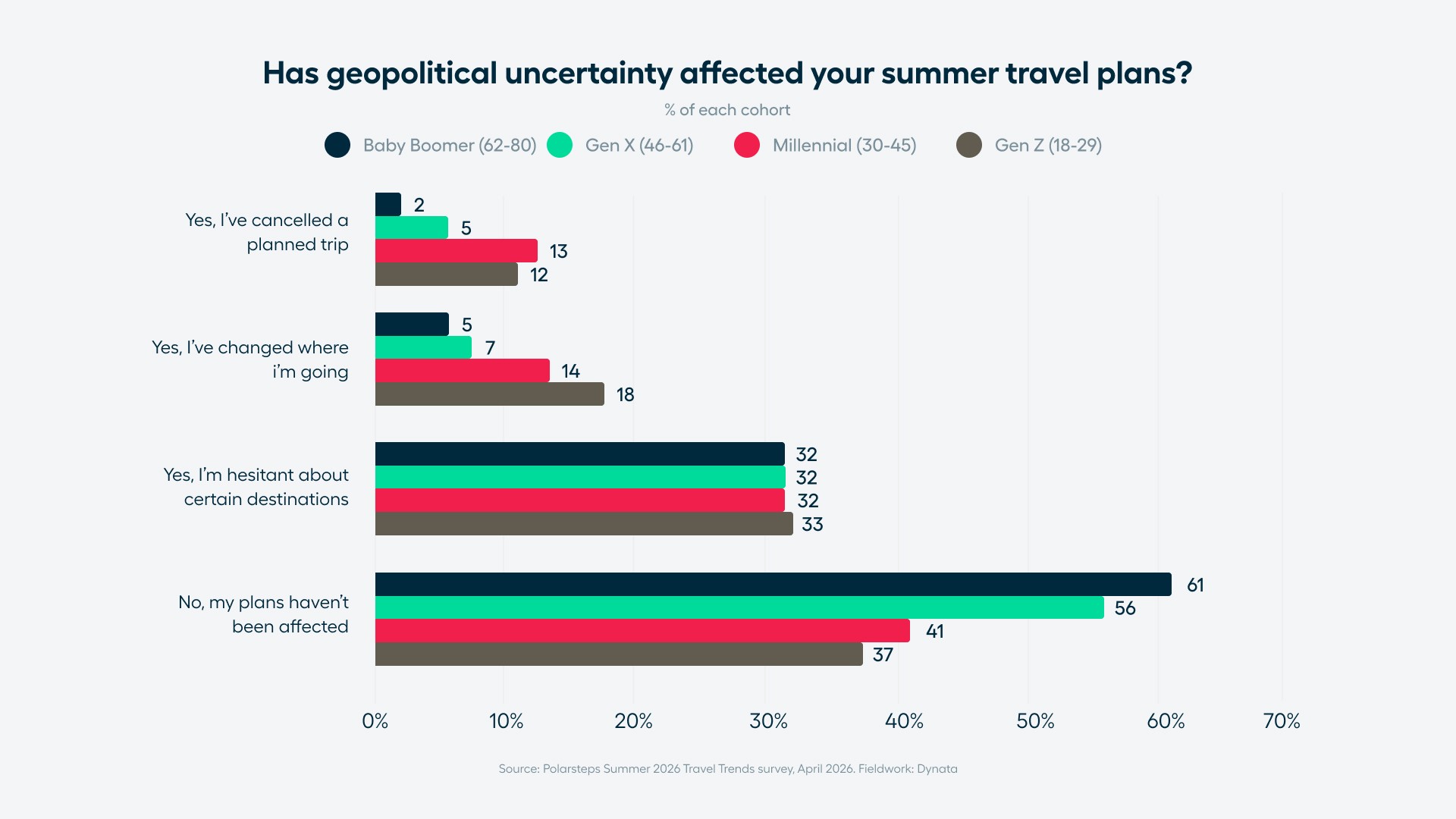
Just under half of the travelers in the Polarsteps summer survey stated the current geopolitical uncertainty in the world had affected them, with 8% choosing to cancel their trip, 10% changing their chosen destination, and almost a third becoming more hesitant about some places to visit. Results also showed that the younger the traveler, the more affected they were, with Gen Z being four times more likely to have cancelled their trip or changed destinations compared to Baby Boomers.
One of the biggest trends emerging has been Europeans’ feelings about traveling to the United States. Looking at Germany, France, and the United Kingdom, 57% of travelers surveyed said they were less likely to visit due to the country’s political climate. Breaking this down by country, travelers from Germany were the most hesitant about the US, with 65% feeling less likely to travel there. British travelers were right on the overall average (57%), while negative sentiment from French travelers was lowest at 48%.
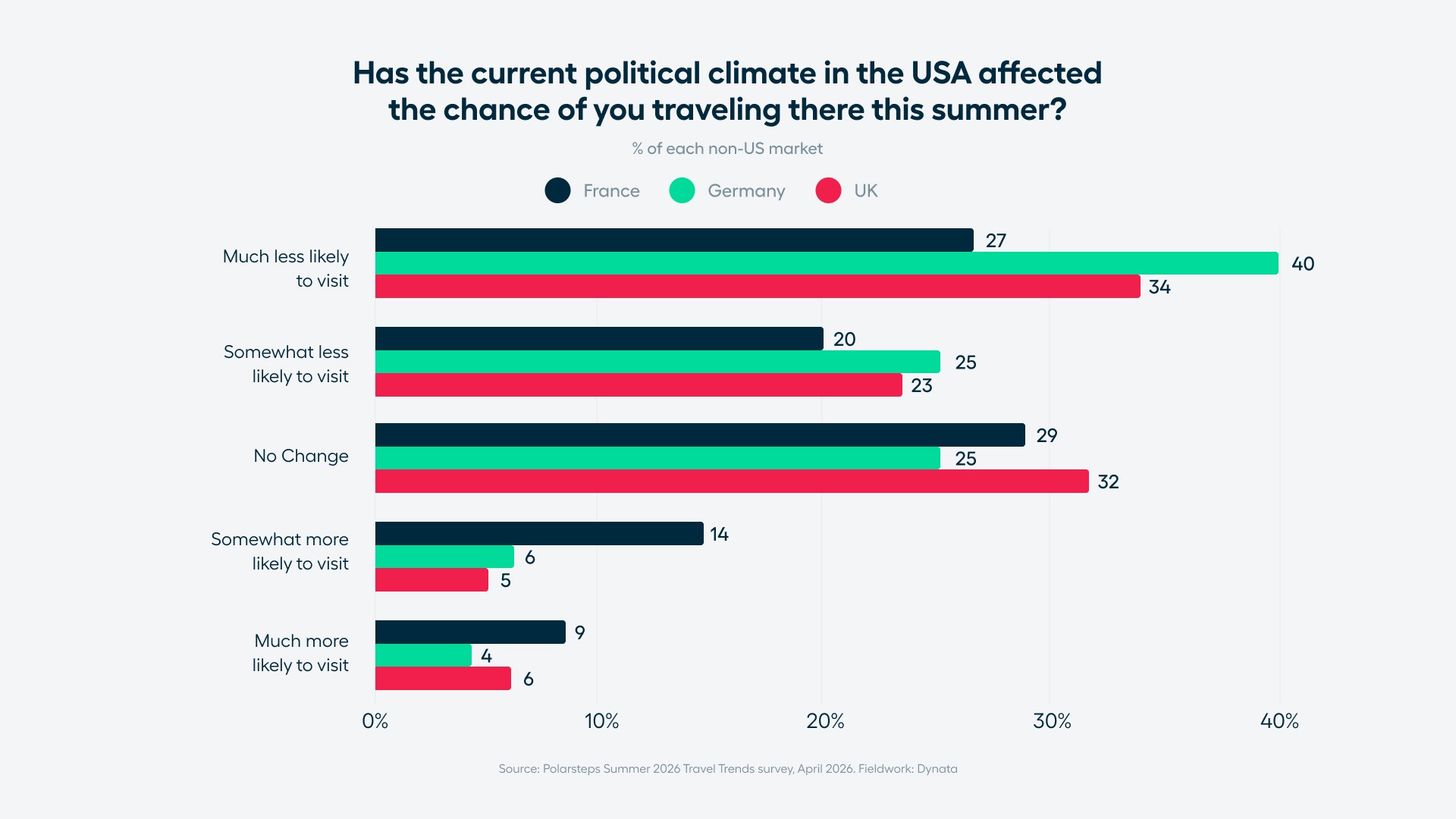
German and British travelers are much less likely to visit the United States due to its political climate than French travelers. Source: Polarsteps Summer 2026 Travel Trends survey.
French travelers were also an outlier in terms of positive US travel sentiment. Almost a quarter said they were more likely to travel to the States, easily double that seen in Germany or the UK. Polarsteps' planning data from French travelers supports this, with trips to the US this summer looking up year-on-year, with it now ranked second behind Italy, up three places from the summer of 2025. Matt Phillips, Head of Editorial at Polarsteps, explains: "Those who are scared off by the current situation might not have been keen on planning a visit regardless, and those who are stalwart fans of the US are being attracted even more.”
Looking across the pond, when American travelers were asked how the current political situation at home was affecting their travel, 37% said they were less likely to travel outside of the United States. In contrast, just under 21% were more likely to travel abroad. Age wasn’t much of a determining factor for those wishing to stay in the States, but it certainly was for those more likely to leave, with Gen Z leading the way. As Clare Jones, CEO of Polarsteps, notes: “Particularly interesting is the fact that young Americans are saying the political climate makes them more likely to travel abroad, showing a thirst for something different (at a rate of more than 3x that of Baby Boomers)."
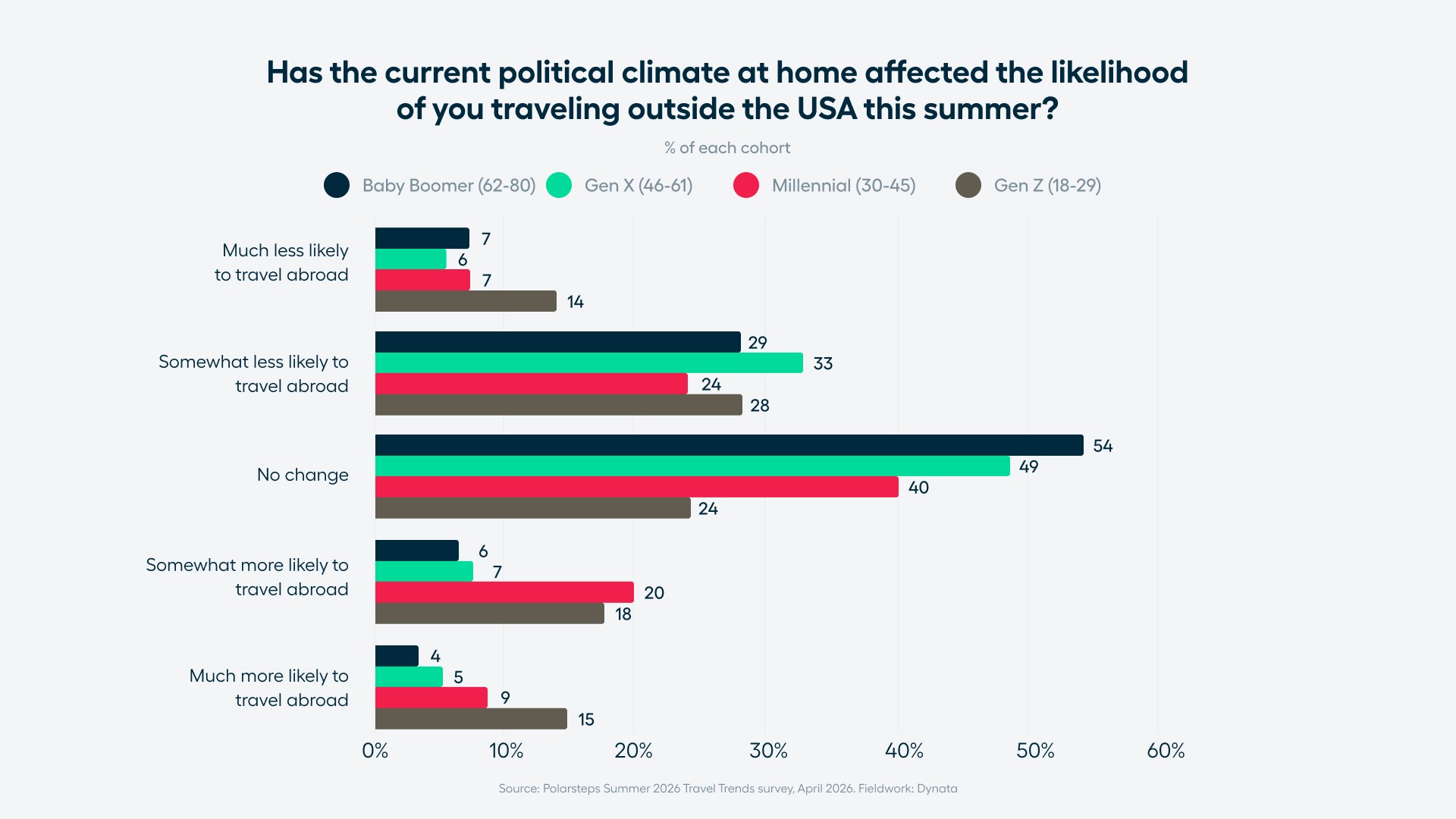
Gen Z is the American generation most impacted by the political climate at home in terms of it affecting their willingness to travel abroad. Source: Polarsteps Summer 2026 Travel Trends survey.
Unity was found on both sides of the Atlantic, and across generations, in one area: around 90% of all respondents said safety and political stability were on their mind when planning summer travel this year.

With global inflation rising and potential fuel shortages looming due to the fallout of the Strait of Hormuz’s closure, it would be understandable if discretionary spending on travel took a hit. Yet, almost 42% of respondents say they are planning on spending more on travel this summer, with only 12% planning to spend less.
The extent of this desire to spend more varies across both countries and generations. American travelers were the most bullish, with 52% planning to increase travel spending. British were a close second at 48%, while German and French travelers were significantly less likely, with 39% and 30% of respondents saying the same, respectively.
In terms of generational differences in travel spending this summer, Gen Z was clearly the most positive, with 55% planning to increase their travel budget. This figure dropped to 44% for Millennials, 34% for Gen X, and 40% for Baby Boomers, highlighting it’s not simply tied to age.
"We're seeing a deepening trend for authentic, real-life experiences, and travel is a huge part of that,” says Clare Jones. “Despite the financial difficulties of economies right now, the resilience of travel shows how important real, rather than digital, experiences still are for people in their spending planning."
Although word-of-mouth remains the most powerful force in travel, its grip is weakening, with just a third of surveyed travelers now saying that friends and family are their single biggest influence on where to go. Gen Z is leading this shift, with less than a quarter relying on their loved ones, while Baby Boomers sit at the opposite end of the spectrum at 42%.
Beneath that, the picture is splintered. Despite being the newest arrival on the scene, AI tools rank top for 7% of respondents, meaning they have already surpassed both Instagram and another relative newcomer, TikTok, which sit at 5% and 6% respectively. This trend is being driven by Millennials, who are the biggest users of AI tools, and Gen Z. That said, the favorite digital tool of Gen Z — chosen by one in five — is now TikTok.
With both Gen X and Baby Boomers heavily favoring travel blogs/websites and traditional media as their prime source of inspiration, these established sources still rank above TikTok, Instagram, and YouTube in terms of total percentages across all ages (18% and 10%, respectively). Unity across generations was found with travel apps, which were the top choice for an average of 15% of all respondents, ranking it third overall. But some digital platforms driving inspiration are also driving disappointment.
"What’s interesting to me is that we’re increasingly relying on one form of algorithmic influence or another. It makes it even more important for travelers to stay curious and check suggestions with their own research or, better yet, real humans," says Clare Jones.
More than a third of travelers have arrived at a destination and felt it didn't match what they saw on social media. This figure rises to 59% among Gen Z, the very generation most reliant on those platforms. The gap between the feed and the destination is stark.
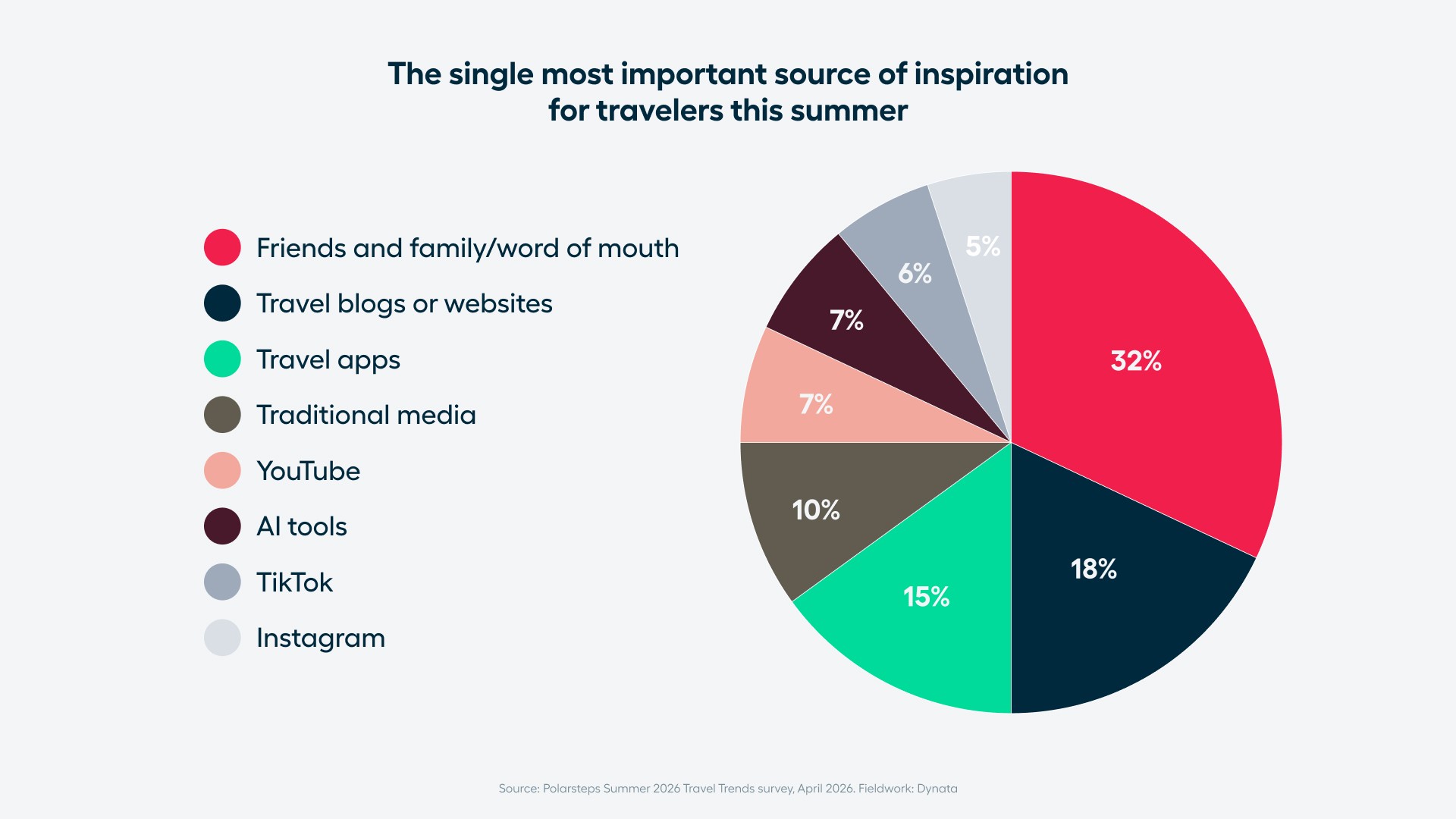
Friends and family remain the single most important source of travel inspiration, but face growing competition from many other media. Source: Polarsteps Summer 2026 Travel Trends survey.
AI has made huge inroads in a short amount of time. Almost 40% of respondents are using (or planning to use) AI to help with their travel plans this summer. The vast majority of these travelers, between 72-81% across all ages and nationalities surveyed, are using it for getting destination tips and practical information.
Apart from that universal use case, each country tends to rely on AI for different aspects of the planning process. For instance, French travelers are the most likely to use it for building itineraries, while British travelers rely on it to help choose their destination more than the other nations. And travelers from the United States harness it more than anyone else for finding flights and accommodations, and making bookings.
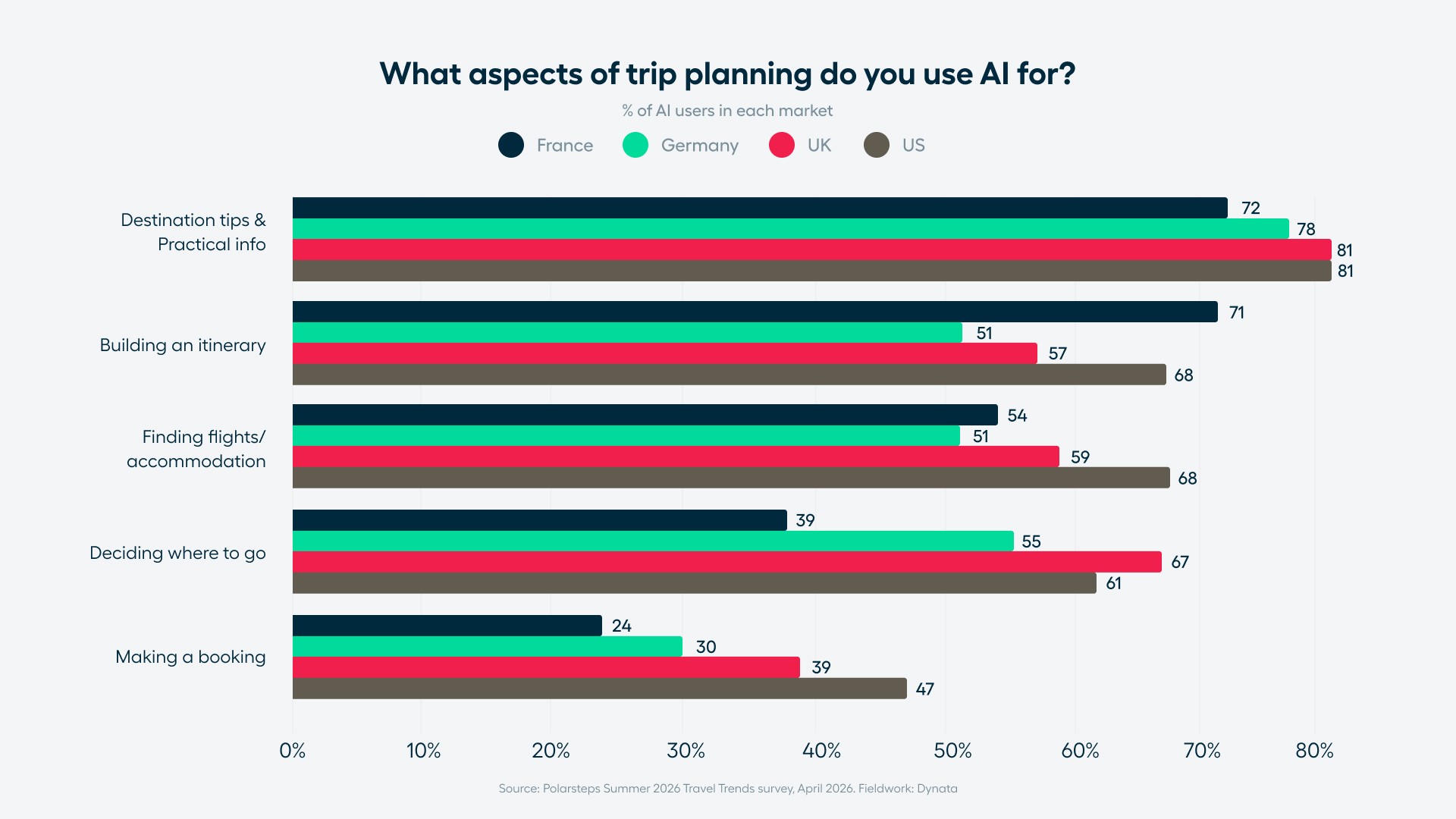
How travelers use AI in trip planning varies by country, though all prioritize it for destination tips and practical information. Source: Polarsteps Summer 2026 Travel Trends survey.
With two-thirds of them planning to avoid using it for this summer’s travel plans, German travelers are the most suspicious of AI for travel planning. This feeling seems to carry through to those of them who have been using it, with German travelers having the highest percentage of negative feedback on AI results and the lowest percentage of positive feedback.
Matt Phillips poses the question: “Are Germans more critical because they're more reluctant adopters who came in skeptical, or more reluctant because they've had worse experiences?”
Across all respondents of the survey, only 8% said they had received a recommendation that was clearly wrong, with 68% believing that AI output had been accurate overall.
Looking at hundreds of thousands of trips already planned in the Polarsteps app, as well as a grouping of 75,000 planned trips from France, Germany, the United Kingdom, and the United States, some travel trends are emerging.

Europe has a stranglehold on the top countries that Polarsteps travelers are planning to travel abroad to this summer. Nine of the ten most popular nations are from the continent, with Italy being the runaway winner, and France and Spain taking second and third places, respectively. The United Kingdom, Greece, Norway, and Portugal have also climbed higher into the top ten.
“With more than 12 million Polarsteps travelers based in the Netherlands, France, and Germany, it’s not surprising that Europe is the strongest-performing continent for planned travel this summer,” says Matt Phillips. “However, not all of last year’s top European performers have fared well.”
Compared to rankings based on tracked trips during the summer of 2025, Switzerland has dropped substantially (7 to 18), as have Denmark (8 to 15) and Austria (5 to 9). Looking beyond Europe, there have been mixed results, too.
Nations of note that have made big leaps this year include Canada (19 to 11), Japan (26 to 16), Iceland (34 to 22), and Vietnam (31 to 23). Africa’s greatest climbers of 2026 are Namibia (64 to 48) and South Africa (44 to 37).
The two biggest drops in the global rankings for planned trips this summer are Qatar (37 to 87) and the United Arab Emirates (25 to 51), both reflecting the impact of the conflict in the Middle East. Turkey (23 to 31) has also fallen in all key markets.

Italy remains the top choice for French travelers this summer, in line with global trends. What stands out, however, is that France has a much stronger long-haul preference than Germany or the United Kingdom. Both the United States and Canada rank higher as destinations than in those markets, and the same can be said for Japan and Indonesia.
Japan (19 to 5) is the biggest climber compared to the summer of 2025. Although not in the top 10, Vietnam (24 to 17), Malaysia (27 to 22) and South Korea (43 to 25) all had large climbs in the rankings. Iceland (31 to 19) is also notable. Switzerland (4 to 14), Belgium (13 to 27), the Netherlands (15 to 24), and Turkey (22 to 35) had the largest falls.
Countries with the most planned trips: French travelers (2025 tracked trips ranking in brackets)
Italy ( 1 )
United States ( 5 )
Spain ( 2 )
Canada ( 10 )
Japan ( 19 )
Indonesia ( 9 )
United Kingdom ( 7 )
Portugal ( 6 )
Germany ( 3 )
Greece ( 8 )
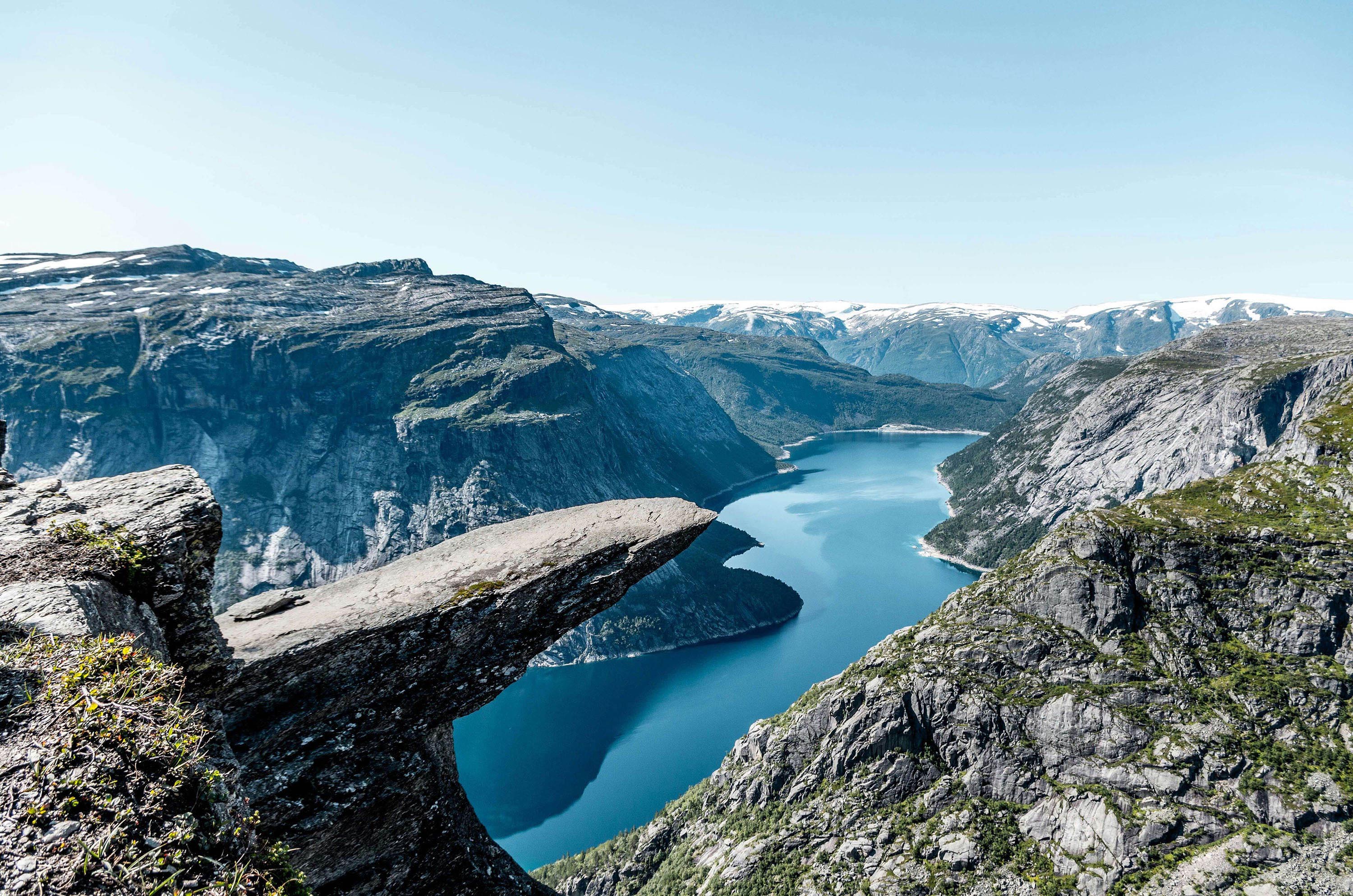
The social order, unspoiled nature, and cooler summer temperatures of the Nordics are proving to be an even stronger pull to German travelers this summer compared to last, with Norway, Sweden, and Denmark claiming third, fourth, and fifth places, respectively. Neighbor Austria (3 to 7) had the biggest fall in the top ten.
Not in the top ten, but the biggest movers in the German market’s top 25 were Australia (41 to 25) and Japan (33 to 19). Other long-haul winners include Sri Lanka (45 to 37), Malaysia (33 to 24), and Singapore (34 to 27). Like in the French market, Iceland (28 to 18) and Canada (21 to 11) have both climbed, and Turkey has dropped (22 to 32).
Countries with the most planned trips: German travelers (2025 tracked trips ranking in brackets)
Italy ( 1 )
France ( 2 )
Norway ( 6 )
Sweden ( 5 )
Denmark ( 4 )
Spain ( 7 )
Austria ( 3 )
United Kingdom ( 11 )
United States ( 12 )
Portugal ( 16 )

British travelers are incredibly Europe-focused with their travel plans this summer, with 62% of planned trips including France, Italy, Germany, or Spain in their itineraries. France is the clear winner, playing a part in a remarkable 21% of all planned trips.
The lure of the Alps and Adriatic has pushed Switzerland (7 to 5), Austria (10 to 6), Croatia (11 to 8), and Montenegro (31 to 25) further up the rankings compared to the summer of 2025. Similarly, mountains, culture, and coasts, in conjunction with lower travel costs, have also pulled up Slovenia (18 to 12), Czechia (20 to 15), Poland (27 to 20), and Slovakia (35 to 30). While some long-haul destinations have boomed, particularly Brazil (52 to 35) and Japan (32 to 22), others have dropped substantially, such as Singapore (26 to 38) and Australia (19 to 26).
Countries with the most planned trips: British travelers (2025 tracked trips ranking in brackets)
France ( 1 )
Italy ( 3 )
Germany ( 4 )
Spain ( 2 )
Switzerland ( 7 )
Austria ( 10
Netherlands ( 5 )
Croatia ( 11 )
United States ( 9 )
Greece ( 8 )
More than any other market examined, American travelers are incredibly long-haul focused in their planned trips for this summer, with nine of the top ten destinations at least an ocean away. Classic Western European countries dominate the list, with the only outlier being Japan (13 to 10).
Outside of the top ten, the biggest climbers compared to last summer were the Philippines (68 to 40) and New Zealand (58 to 39). Aspirational long-haul destinations such as these seem to be luring travelers away from traditional short-haul destinations, such as Canada (2 to 4), Mexico (16 to 21), and Costa Rica (29 to 33).
Countries with the most planned trips: American travelers (2025 tracked trips ranking in brackets)
Italy ( 4 )
United Kingdom ( 3 )
France ( 1 )
Canada ( 2 )
Spain ( 6 )
Germany ( 5 )
Ireland ( 9 )
Switzerland ( 8 )
Portugal ( 12 )
Japan ( 13 )
About Polarsteps
Recognized as one of Europe’s hottest scale-ups, Polarsteps is the market-leading travel app that helps over 20 million travelers worldwide to plan, track, and relive their adventures in a beautiful and seamless way. Using pioneering technology and design, the all-in-one app builds itineraries, maps travelers’ paths across the globe in real time, and provides a new way to share travel experiences. Headquartered in Amsterdam and powered by an international team of 100+ passionate travelers, we’re becoming the essential tool for modern-day explorers — before, during, and after their trips.
Traveler research for Polarsteps’ Summer Travel Trends Report was conducted in April 2026 by Dynata, one of the world’s largest first-party data and insights platforms. A representative sample of 2,403 adults, all of whom were actively planning at least one international trip during the summer of 2026, were surveyed evenly across four markets — the US, UK, Germany, and France.
Trip trends for individual markets are based on anonymized data from 75,000 planned trips in the Polarsteps app for summer 2026, captured on April 15, 2026.